Description
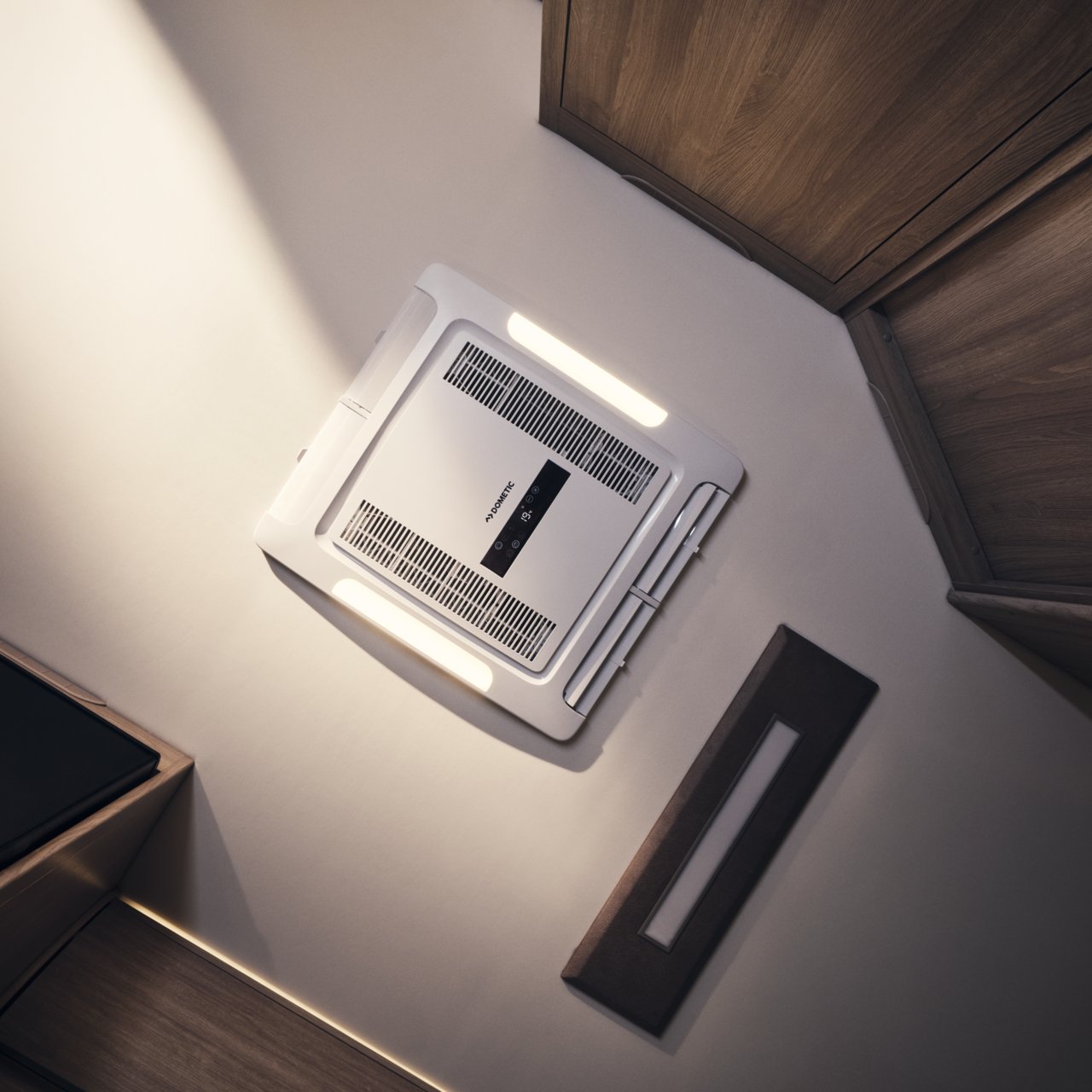
- Optimized airflow for increased efficiency and reduced noise
- Integrated touch control display – unique in the market
- Integrated lighting – cool white LEDs for soft ambient light
- Vertically adjustable outlet vents for individual airflow regulation
- CleanAir air purifier system – keeps your RV smelling fresh and clean
- Low-profile design (just 68 mm high) leaves more headroom in the cabin
- Reusable dust filter – easy to remove for cleaning
Specifications
SKU: 9600051008
| Model | FJXADBD |
|---|---|
| Scope of delivery | ADB, Manuals, Remote control, installation material |
| SKUCertificates | CE;UKCA;ECER10;EMC;CB |
| Product Description | Air distribution box, electronic controls, LED light |
| Dimensions product depth, [mm] | 579 |
|---|---|
| Dimensions product height, [mm] | 48 |
| Dimensions product width, [mm] | 518 |
| Net weight, [kg] | 3.90 |
| Cut out depth, [mm] | 400 |
| Cut out width, [mm] | 400 |
| Connectivity Type | Bluetooth |
|---|
| Dimensions parcel depth, [mm] | 630 |
|---|---|
| Dimensions parcel height, [mm] | 140 |
| Dimensions parcel width, [mm] | 550 |
| Parcel weight, [kg] | 6 |


Highlights
Optimized airflow
Low-profile air distribution box with powerful front and back airflow
Intuitive touch control
Simply set the temperature and blower level you want
CleanAir technology
Effectively reduces bacteria and odors to keep your RV smelling fresh and clean
Adjustable outlet vents
Simply adjust the direction of the airflow with your fingertips
Integrated lighting
Warm white LEDs create a beautiful, soft ambient light
Reusable dust filter
Easy to remove for cleaning
Dometic Climate App
Easily control and monitor your climate from the palm of your hand
Dometic CleanAir air purifier
Our new air purification system uses advanced bipolar ionizer technology to keep your RV smelling fresh and clean while greatly reducing allergens, viruses, bacteria and pollutants. Ionizers purify air through several methods. First, they create positive and negative ions to help reduce pathogens, odors, and mold. Bacteria and virus cells are robbed of their life-sustaining hydrogen, reducing their number. Secondly, odors are reduced when they oxidize on contact with the charged ions. Last but not least, the positive and negative ions attach to the particles in the air. Their attractive forces make the particles bigger. This in turn allows the standard dust filter of your air conditioning system to remove more particles from the air.
2 questions
If you are travelling to cooler climates then this will not challenge the air conditioners to the extremes, a unit with a smaller power rating will do for these types of trips. You should not save on power, though, if you regularly travel to warmer climates and even less so if you have children or pets on board as staying in a recreational vehicle can quickly become uncomfortable on a hot summer day. When the nights are not cooler either, rest and recuperation is only possible with an adequate air conditioner.
Air conditioners work on basically the same principle as the cooling units of kitchen refrigerators. Their cooling efficiency is way higher though. In either system a refrigerant extracts heat from the space to be cooled and dissipates it to the outside. An RV air conditioner should additionally reduce the humidity. AC systems most commonly used for recreational vehicles:
Evaporation systems: Water is vapourised in a roof-mounted unit and collected in a filter. A fan draws ambient air in through the filter, which results in a heat exchange. Benefits: low current consumption, lightweight. Drawback: The energy efficiency depends on the ambient humidity; so the performance of the system varies. It drops when the humidity is > 85% – and that's exactly the level where air conditioning is needed. Moreover, evaporation systems will, by nature increase the humidity in the vehicle, regardless of the ambient conditions.
The temperature conditions in recreational vehicles and the reasons behind them RV and caravans are no houses and they don't have thick walls, even if they are reasonably insulated they will heat up in the sun. The temperature inside can quickly rise to 30°C or more and not only in the hot and sunny south, but also in moderate climate zones. Besides insulation, the temperature conditions inside the vehicle depend on other factors, too: the size and number of windows, for instance. A caravan with small windows will heat up less quickly than a RV with generously sized glass surfaces and it does of course matter where you park your vehicle – in the blazing sun or in the shade of a tree. Do you take every opportunity to air the vehicle out? Or are all the windows closed and the heat can spread throughout the interior?