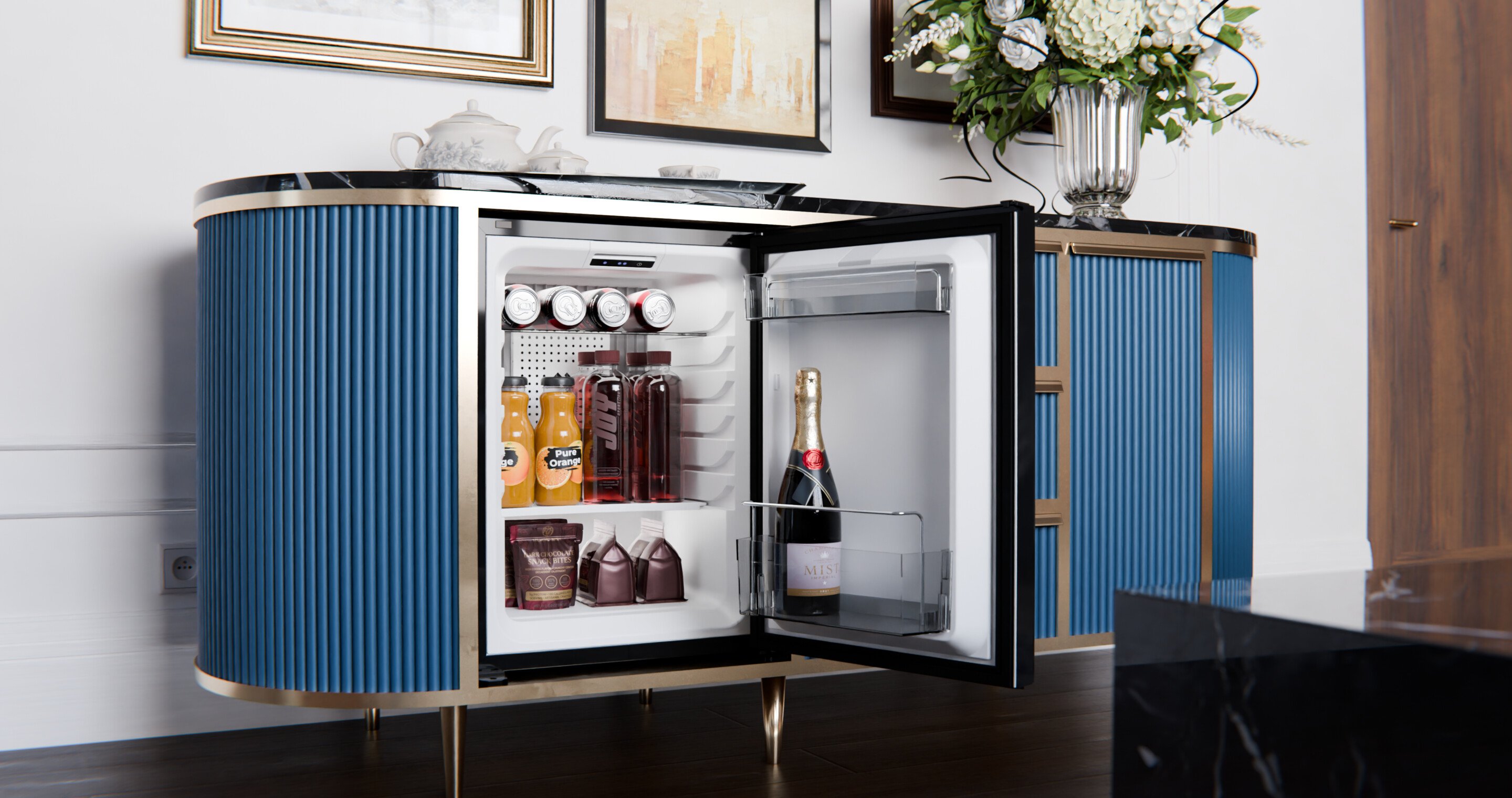
1) Silent operation: protect sleep, protect satisfaction
Across segments, quiet operation is the non‑negotiable. In our study, 53% of US travelers and 70% of German travelers selected silent operation as a leading feature for the minibar or mini fridge. When asked to trade off, 82% of US respondents and 89% of German respondents chose “silent” over “lowest energy consumption.”
Why it matters for your project: sleep quality is tightly linked to overall satisfaction. Independent research associates poor sleep with lower guest satisfaction, with HVAC or equipment noise cited among common disruptors. Hotels that reduce in‑room noise see measurable uplifts in perceived value and satisfaction. Harvard Medical School researchers reporting on hotel sleep and satisfaction (opens in new tab) and peer‑reviewed analysis in Tourism and Hospitality Research document this link (opens in new tab).
What to specify and ask suppliers:
Align minibar technology to your noise and climate profile. Compressor units can be efficient but must be carefully selected and installed to control noise, while absorption offers 0 dB operation with well‑planned ventilation and cabinetry.
2) Flexible storage: ready for large bottles and varied assortments
Guests want room for real‑world use. Space for large bottles stored upright was selected by 48% of US travelers and 45% of German travelers. Adjustable shelves and simple interior layouts also rank highly.
Design guidance:
Prioritize door racks that secure 1.5‑liter bottles upright and adjustable shelf positions to support a rotating mix of local items, premium beverages, and health‑oriented snacks.
Use clear internal wayfinding, so guests can see what is available without rummaging. In markets or room types that favor merchandising, consider a glass door with balanced lighting; in others, integrate behind furniture panels.
3) Intuitive minibar controls and straightforward temperature adjustment: fewer service calls, better guest experiences
Clear, accessible controls and adjustable temperature matter. Forty percent of US travelers and 38% of German travelers call out temperature adjustment as important, and guests consistently prefer controls that are easy to reach and simple to understand.
Operations impact: intuitive controls reduce front desk calls, cut room‑level interventions, and help maintain product quality. J.D. Power notes that straightforward in‑room controls are one of the most cost‑effective ways to improve perceived value.
Specification tips:
Favor tactile, labeled controls with clear set‑points.
Ensure easy operation and clear manuals.
4) Design integration and access: fit the room, fit the workflow
Design preferences vary by market and segment, but clarity is consistent. A majority of US travelers prefer minibars with transparent doors and interior illumination (56%), while most German travelers prefer hidden, furniture‑integrated units (62%). Guests in both markets want easy access; unlocked minibars are preferred by 81% in the US and 92% in Germany. Restocking expectations differ by segment, with daily restock preferred by German travelers and by many five‑star guests in the US.
How to decide:
Match presentation style to your brand’s design language and the room’s purpose. Transparent doors can support retail presentation in lifestyle or resort contexts; hidden units may suit classic or luxury schemes where the minibar should blend into millwork.
Plan service paths. If your positioning or segment expects daily restock, confirm cabinet ventilation, pull‑out clearances, and hinge swing to support fast, silent service.
5) Manual payment and clear pricing: reduce disputes and build trust
Guests want confidence at checkout. Our study shows a clear preference for manual payment over automated billing: 70% of US travelers and 61% of German travelers favor declaring consumption to staff rather than sensor‑triggered charges. On pricing, US travelers are split between pricing on each item and a menu card, while 65% of German travelers prefer a menu card with prices.
Practical options you can implement now:
Use plain, bilingual pricing where needed, either on‑item or via a clearly visible menu card placed inside the door.
Align billing flow with your service model. If your segment values high touch, manual verification at checkout can reinforce trust; if you rely on automation, ensure staff can instantly reverse questionable charges.
Regional nuances that inform design choices
US: Many leisure travelers expect a minifridge for personal items, and a slight majority favor a transparent door in premium or lifestyle contexts. Business travelers and five‑star guests show higher expectations for assortment breadth, accessibility, and sometimes daily restock.
Germany: In‑room minibar importance is strong among five‑star and business travelers. Hidden integration, daily restock, and menu‑card pricing are preferred, and silence is especially critical.
Procurement checklist you can copy into your spec
Use this as a quick brief to align design, operations, and finance.
Noise: Target silent or near‑silent operation in occupied rooms, validate cabinet ventilation, and include vibration isolation details in shop drawings.
Storage: Require upright 1.5‑liter bottle storage in the door, adjustable shelves, and clear interior lighting.
Controls: Provide guest adjustable temperature settings through tactile, clearly visible minibar controls.
Design: Choose minibars with glass doors or hidden integration based on brand standards and market expectations. Confirm service clearances for fast restock.
Access and restock: Default to unlocked. Define daily vs upon‑request restock by segment and property positioning.
Payment and pricing: Default to manual billing in most segments; publish clear prices on items or a menu card. If using automation, include a grace window and simple dispute‑resolution workflow.
Conclusion: a minibar that works for guests and for you
When your minibar is quiet, flexible, intuitive, well‑integrated, and clearly priced, it earns trust and reduces friction for staff. That is what today’s travelers say they want, and it is where hotels see better satisfaction and fewer complaints. Our team is ready to help you configure a solution that fits your brand, your rooms, and your operations.
About the research behind these recommendations
Dometic partnered with a global panel provider to survey 2,039 travelers who stayed in a hotel within the past six months, split across the United States (n=1,018) and Germany (n=1,021). The online survey captured usage and preference data for in‑room minibars and minifridges, including feature trade‑offs, design preferences, payment and pricing formats, and restocking methods. Fieldwork and analysis were completed in 2025.
References
Robbins, R., et al. “Hotel Guest Sleep and Overall Hotel Satisfaction.” HospitalityNet press summary of peer‑reviewed study. HospitalityNet. (opens in new tab) Original peer‑reviewed article: “Examining key hotel attributes for guest sleep and overall satisfaction.” Tourism and Hospitality Research. SAGE Journals PDF. (opens in new tab)
ASHRAE resources on acoustics and HVAC noise control. ASHRAE Handbook chapter index (opens in new tab), Acoustics basics for HVAC designers. (opens in new tab)
Automation practices for minibars, including guest‑friendly safeguards. “Momentary pickup” explanation (opens in new tab), Hotel Online automation overview. (opens in new tab)
Dometic proprietary research figures in this article are taken from “Hotel minibar and minifridge usage and preferences, 2025,” US and Germany sample, conducted with a global research partner.

Want more exciting insights like this?
Subscribe to the Dometic Professional Newsletter today