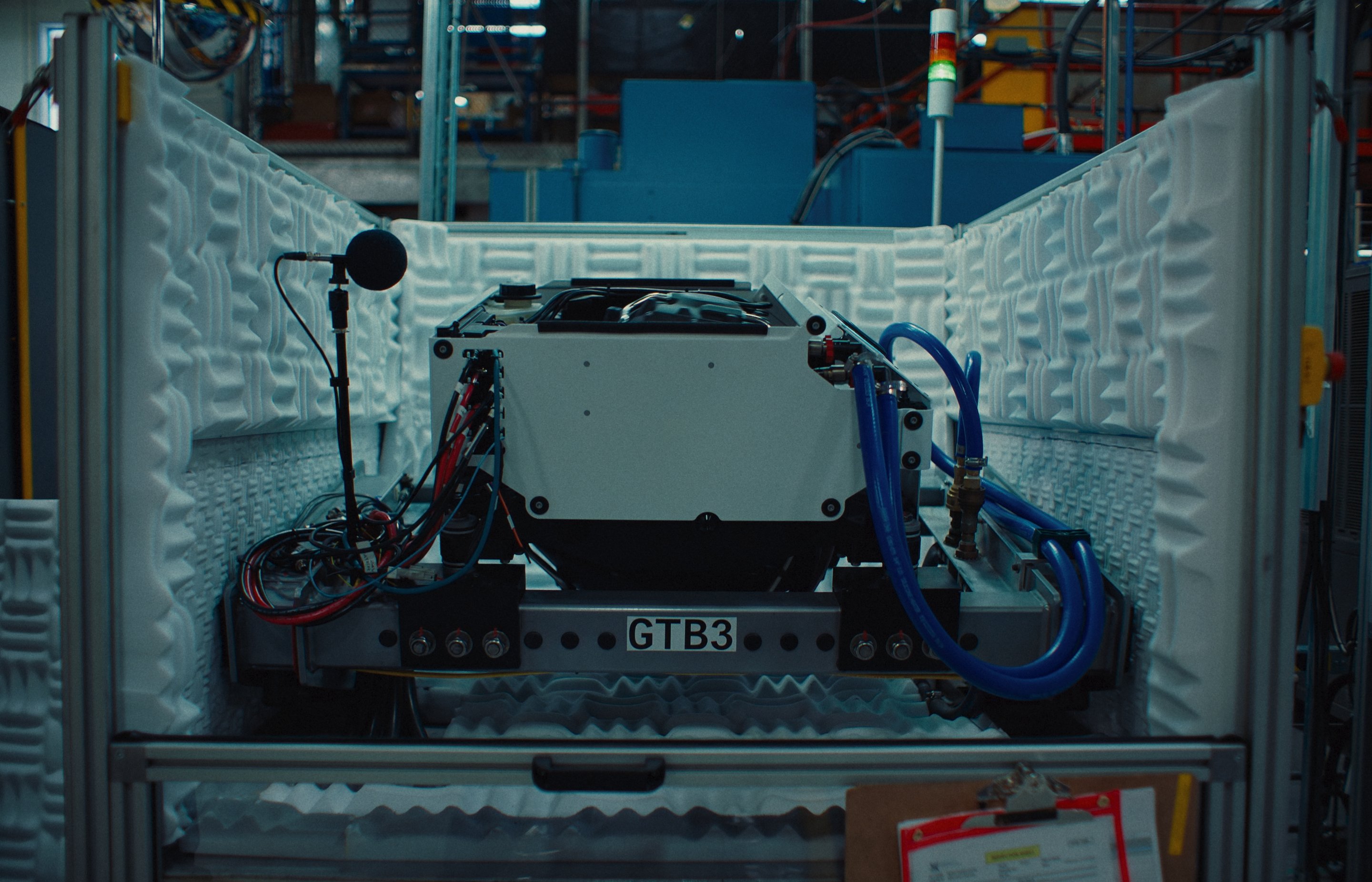
The hydraulics problem
Traditional gyro stabilisers use hydraulic systems to control precession — the tilting motion of the flywheel that generates the stabilising force. Hydraulics work, but they introduce lag. They add complexity. They require maintenance. And when conditions change quickly, lag in the precession response means lag in the stabilisation.
The DG3 removes hydraulics entirely. In their place is an Electric Precession actuator that adjusts the flywheel's precession angle in real time, responding directly to sea state with no hydraulic delay. The result is a system that's faster to respond, more precise in its correction, and effective across a wider range of conditions — mild chop or heavy offshore swell.
No hydraulics also means fewer service requirements. That matters on a product designed to be aboard for years.
Flywheel physics — and why RPM isn't the whole story
A common misconception is that a faster flywheel always means a better gyro. The DG3 operates at 4,700 RPM — lower than some competitors — but delivers an angular momentum of 3,000 N·m·s. The same anti-rolling capability, achieved at lower rotational speed through a better flywheel design, utilizing a larger diameter flywheel with mass concentrated more towards the center. Lower RPM means lower wear and lower energy consumption.
That 40% reduction in power consumption compared to comparable systems isn't incidental — it's a direct result of how the flywheel is designed.
Energy that doesn't disappear
The DG3's Gyro Control Unit manages power throughout the full operating cycle. During spin-down, the motor recaptures kinetic energy from the decelerating flywheel and redirects it back into the dedicated 48V spin battery. Power that would otherwise be lost is put back into the system.
In practical terms: the house bank takes less of a hit. Electronics, refrigeration, and navigation systems stay powered on long offshore runs. And the 48V spin battery is fully maintained by the Gyro itself — no separate charging infrastructure, no additional system to manage. Compatible with 12V, 24V, or 48V house systems.
On-demand stabilisation — what it actually means
Spin-up time has historically been one of the limitations of gyro stabilisers. The DG3 reaches stabilisation-ready in 9 minutes. Full operating speed in 16.5. That's up to three times faster than comparable systems.
The spin-down completes in under 20 minutes, with energy recaptured throughout. Pull up at anchor — spin down. Ready to leave — spin back up. The window between decision and stabilised vessel is genuinely short enough to change how boaters use the technology day to day.

Built to stay in the water
Long-term performance starts with cooling. The DG3 uses a parallel path cooling system with an on-demand raw water cooling loop and a titanium heat exchanger — corrosion-resistant, eliminating the need for sacrificial anodes. Internal bearings are larger sealed bearings rather than the bushings found in comparable units, configured for longevity under continuous marine load.
The outcome is a unit that is virtually maintenance-free. Backed by a 3-year / 3,000-hour warranty.
Understanding the engineering of the DG3
The DG3 isn't differentiated by a single feature. It's the combination — hydraulic-free precession, intelligent energy management, faster spin-up, lower power draw, and durability engineering that removes ongoing service burden — that separates it from the alternatives.
For boaters evaluating gyro stabilisation for the first time, or upgrading from an older system, the technical case is clear. Knowing why it works the way it does makes it easier to make the right decision.