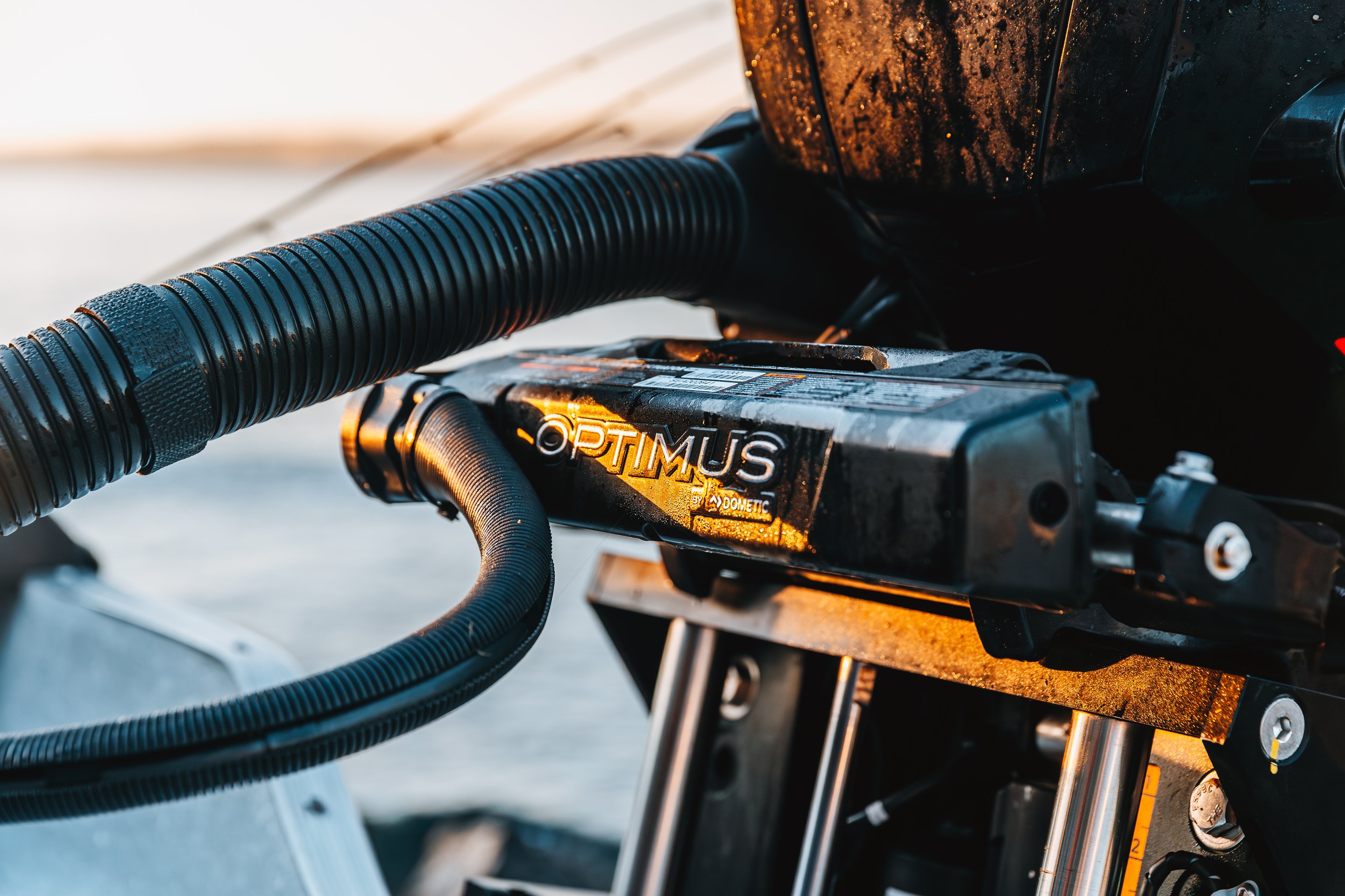
The hydraulic steering system has been the marine industry standard for decades. It works. It's proven. And it comes with a set of well-understood limitations — fluid lines that can leak, pumps that require maintenance, a fixed helm feel that can't adapt to conditions, and an architecture that offers limited integration with the electronics-rich environment of the modern vessel.
The Dometic Optimus Electronic Power Steering System was built to replace all of it.
What Fly-by-Wire Means in Practice
Fly-by-wire steering replaces the mechanical and hydraulic connection between the helm and the steering actuator with an electronic signal path. The helm reads the operator's input, interprets it through the system's control architecture, and commands the actuator — all in milliseconds, with no fluid, no pumps, and no physical linkage between input and output.
For the person at the helm, the experience is immediately different. The feel is consistent, smooth, and adjustable in ways that hydraulic systems simply cannot match. For the vessel owner, the maintenance picture changes fundamentally — no fluid to check, no lines to inspect for leaks, no pump service intervals to track.
Optimus delivers this experience for vessels from 20 to 130 feet — a range that covers the vast majority of recreational, commercial, and semi-professional marine applications.
A Steering Feel That Adapts to the Vessel's Speed
One of the most significant capabilities of the Optimus system is its speed-adaptive helm response, a characteristic that no hydraulic system can replicate.
At low speeds, manoeuvring at the marina, navigating a channel, approaching a dock — the helm is light and responsive, requiring minimal effort to achieve significant rudder movement. This is exactly what you want when making slow, precise inputs in confined spaces.
At higher speeds, the system automatically increases helm resistance, providing a firmer, more planted feel that matches the vessel's directional stability at speed and prevents overcorrection. The transition between these states is continuous and seamless — the system is always reading vessel speed and adjusting accordingly.
The helm resistance and lock-to-lock turns are also fully customisable by the operator — allowing the steering feel to be configured to match individual preference, vessel type, and operating conditions.
The result, in Dometic's own terms, is steering that is light at idle, firm at high speed, and always predictable.
Multi-Layer Redundancy: Engineering for the Worst Case
In marine environments, the consequences of a steering failure are serious. The Optimus system was engineered with this reality at its core — and the redundancy architecture reflects it.
Dual independent power paths ensure that a single power interruption cannot result in a loss of steering. If one power path is affected, the system continues operating on the other — transparently, without operator intervention.
Multiple position sensors with continuous real-time validation provide ongoing confirmation that the system's positioning data is accurate and consistent. Any discrepancy between sensors triggers an immediate diagnostic response, not a silent failure.
The independent fault-tolerant CAN network architecture takes this a step further. Even if a CAN communication line is damaged, partially interrupted, or compromised — by water ingress, physical damage, or electrical interference — the system is designed to continue operating. The fault-tolerant design means a single point of failure in the communication architecture does not cascade into a loss of control.
Combined, these three layers represent a redundancy standard that significantly exceeds what is possible with conventional hydraulic steering.
Integration with Leading Electronics and Engine Brands
Optimus has been designed from the ground up for the integrated, electronics-rich vessel environment of the modern boat. The system provides direct integration with all leading autopilot systems, electronics brands, and engine manufacturers — simplifying installation, reducing the complexity of the vessel's electronic architecture, and ensuring the steering system works in concert with everything else on board.
For boat builders and professional installers, this means Optimus slots into existing electronics ecosystems without requiring custom interfaces or workarounds. For operators, it means a seamless, unified experience across the helm.
Hydraulic Power Units and Steering Cylinders: 20ft to 130ft
Alongside the electronic helm and control architecture, Dometic provides a complete range of hydraulic power units and steering cylinders to complete the Optimus installation across the full vessel size range.
The system is configurable for single or twin cylinder operation — and in twin cylinder applications, Optimus unlocks a set of performance capabilities that go beyond what any conventional steering system can offer.
Speed-adaptive toe in/toe-out allows the system to adjust the rudder angles relative to each other based on vessel speed — either increasing top-end speed by optimising hydrodynamic efficiency or reducing fuel burn at cruise by minimising drag. This is a meaningful performance variable, not a marginal one.
Ackermann steering geometry takes this further by allowing Optimus to control each rudder independently through turns. In a conventional twin rudder installation, both rudders move by the same angle — which is geometrically suboptimal in a turn because the inner and outer rudders are travelling different arc lengths. Ackermann geometry corrects for this, maintaining vessel speed through turns, reducing roll-out, and improving low-speed manoeuvrability in the kind of close-quarters situations where precise control matters most.
Installation: Simplified, Certified, and Field-Proven
Optimus includes an integrated configuration process covering rudder alignment and straight-line correction — reducing the installation complexity that has historically been a barrier to adopting advanced steering systems. On-demand pumps reduce power consumption during normal operation, drawing energy only when the system is actively responding to helm input.
The system's IPX7 rating covers both pumps and electronics, providing submersion-rated protection for the components most exposed to water ingress in the marine engine room environment.
Design certifications for CLASS, RINA, and ABS reflect the engineering rigour behind the system and provide the professional and commercial marine sector with the third-party validation required for regulated vessel types. And with thousands of installations globally, the Optimus system has a field-proven track record that goes well beyond laboratory certification.
Optimus EPS — Specifications at a Glance
Feature | Detail |
|---|---|
Steering type | Fully electric fly-by-wire |
Vessel size range | 20ft to 130ft |
Helm feel | Customisable resistance & lock-to-lock turns |
Speed adaptation | Automatic — light at idle, firm at speed |
Power redundancy | Dual independent power paths |
Position sensing | Multiple sensors, continuous validation |
CAN architecture | Independent, fault-tolerant |
Cylinder config | Single or twin |
Twin rudder features | Ackermann geometry, speed-adaptive toe in/out |
Power units | Full HPU range, on-demand pumps |
IP rating | IPX7 (pumps and electronics) |
Certifications | CLASS, RINA, ABS |
Third-party integration | All leading autopilot, electronics & engine brands |
Optimus Within the Dometic Ride & Handling Ecosystem
Optimus EPS is part of Dometic's complete Ride & Handling product family — a range built around the principle that every system affecting how a vessel moves through the water deserves the same standard of engineering. That family includes hydraulic and electronic steering, SeaStar trim tabs, jack plates, and gyro-stabilisation — all engineered to work together and all available through Dometic's global dealer and distributor network.
For boat builders specifying complete steering packages, and for owners replacing ageing hydraulic systems, Optimus represents the current benchmark.
The Bottom Line
Hydraulic steering solved the problem of its era. Fly-by-wire solves the problems hydraulic steering created, and opens up performance and safety capabilities that weren't previously possible.
No fluid. No pumps. No maintenance headaches. Multi-layer redundancy. Speed-adaptive feel. Full integration. Twin rudder performance geometry. Proven across thousands of vessels in the harshest marine environments on earth.
When conditions push you to the limit — Optimus holds firm. Stable. Responsive. Confident.
This is engineering you feel.
The Dometic Optimus Electronic Power Steering System is part of the Dometic Marine Ride & Handling ecosystem, available through the global Dometic Marine dealer and distributor network.
Find a Dealer here: https://www.dometic.com/en/support/find-a-dealer
See the complete Dometic marine range here: https://www.dometic.com/en/category/boat