Description
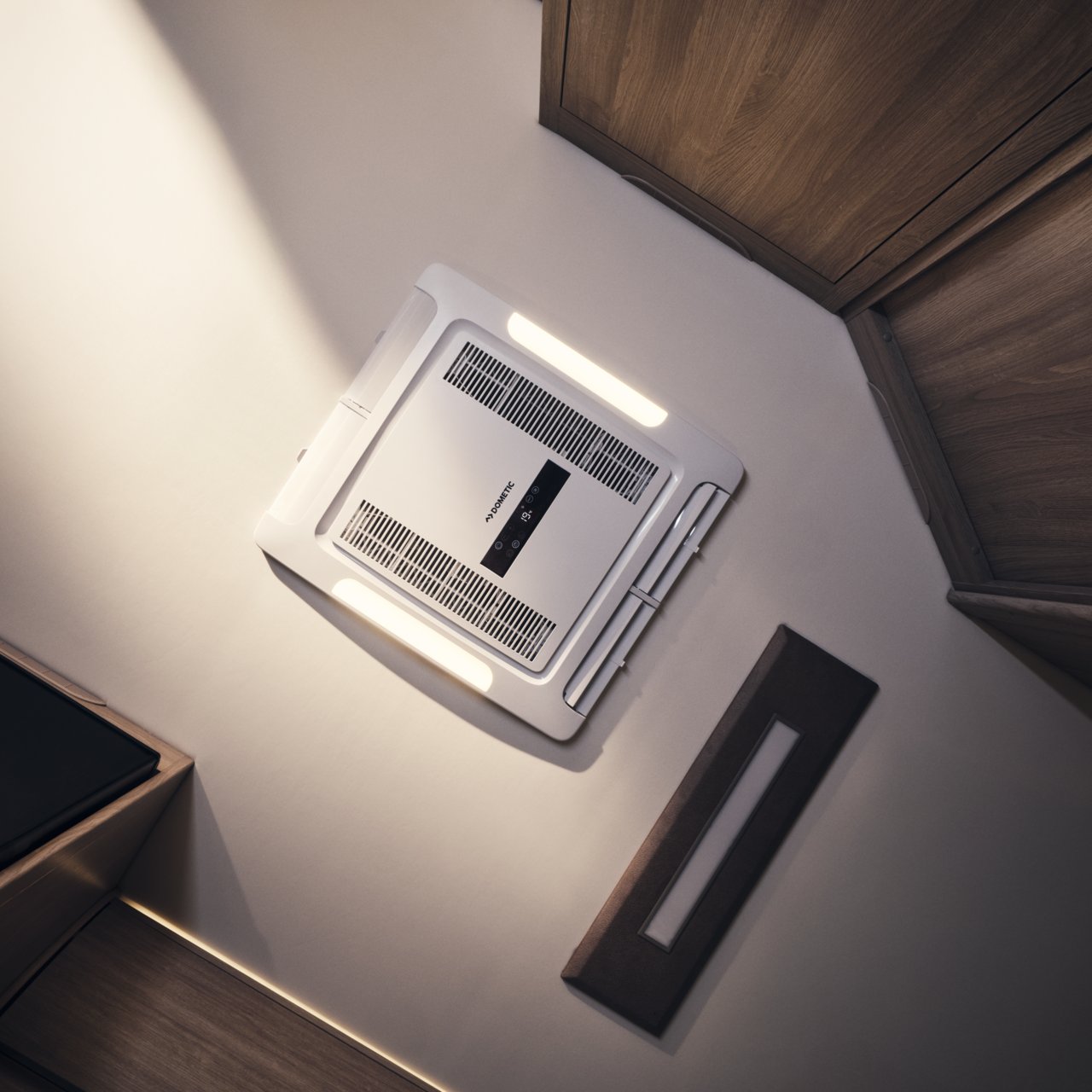
- Flux d’air optimisé pour plus d’efficacité et moins de bruit
- Exclusivité du marché : un panneau de commande tactile intégré
- Éclairage intégré : des LED blanc chaud pour un éclairage adouci
- Évents d’aération réglables verticalement pour un contrôle individuel du débit d’air
- Système de purification de l’air CleanAir : pour un véhicule de loisir qui sent le frais et le propre
- Sa conception discrète (seulement 68 mm de hauteur) économise de la place en hauteur dans l’habitable
- Filtre à poussière réutilisable, simple à retirer pour le nettoyer
Spécifications
SKU: 9600051008
| Model | FJXADBD |
|---|---|
| Scope of delivery | ADB, Manuals, Remote control, installation material |
| SKUCertificates | CE;UKCA;ECER10;EMC;CB |
| Product Description | Boîtier de distribution d’air, commandes électroniques, éclairage LED |
| Dimensions product depth, [mm] | 579 |
|---|---|
| Dimensions product height, [mm] | 48 |
| Dimensions product width, [mm] | 518 |
| Net weight, [kg] | 3.90 |
| Cut out depth, [mm] | 400 |
| Cut out width, [mm] | 400 |
| Connectivity Type | Bluetooth |
|---|
| Dimensions parcel depth, [mm] | 630 |
|---|---|
| Dimensions parcel height, [mm] | 140 |
| Dimensions parcel width, [mm] | 550 |
| Parcel weight, [kg] | 6 |


Highlights
Débit d’air optimisé
Boîte de distribution d’air discrète, flux avant et arrière puissant
Commande tactile intuitive
Réglez simplement la température et le niveau de ventilation souhaité
Technologie CleanAir
Réduit efficacement les bactéries et les odeurs pour un véhicule de loisirs qui respire le frais et le propre
Sorties d’air réglables
Réglez simplement la direction du flux d’air du bout des doigts
Éclairage intégré
Les LED blanc chaud créent une lumière douce et agréable
Filtre à poussière réutilisable
Facile à retirer pour le nettoyer
Application Dometic Climate
Contrôlez votre climatiseur en toute simplicité depuis votre téléphone
Purificateur d’air Dometic CleanAir
Notre nouveau système de purification intègre une technologie avancée d’ionisation bipolaire pour un air propre et sans odeur dans votre véhicule de loisir, tout en réduisant les allergènes, virus, bactéries et polluants. Les ionisateurs purifient l’air de plusieurs façons. Ils génèrent d’abord des ions positifs et négatifs permettant de réduire les agents pathogènes, odeurs et moisissures. Les cellules des bactéries et des virus perdent leur hydrogène vital, réduisant leur nombre. Ensuite, les odeurs sont neutralisées lorsqu’elles sont oxydées au contact des ions chargés électriquement. Et enfin, les ions positifs et négatifs se fixent aux molécules d’air. Leurs forces d’attraction font grossir les molécules. Grâce à cela, le filtre à air de votre climatiseur retient davantage de particules de l’air.
2 questions
If you are travelling to cooler climates then this will not challenge the air conditioners to the extremes, a unit with a smaller power rating will do for these types of trips. You should not save on power, though, if you regularly travel to warmer climates and even less so if you have children or pets on board as staying in a recreational vehicle can quickly become uncomfortable on a hot summer day. When the nights are not cooler either, rest and recuperation is only possible with an adequate air conditioner.
Air conditioners work on basically the same principle as the cooling units of kitchen refrigerators. Their cooling efficiency is way higher though. In either system a refrigerant extracts heat from the space to be cooled and dissipates it to the outside. An RV air conditioner should additionally reduce the humidity. AC systems most commonly used for recreational vehicles:
Evaporation systems: Water is vapourised in a roof-mounted unit and collected in a filter. A fan draws ambient air in through the filter, which results in a heat exchange. Benefits: low current consumption, lightweight. Drawback: The energy efficiency depends on the ambient humidity; so the performance of the system varies. It drops when the humidity is > 85% – and that's exactly the level where air conditioning is needed. Moreover, evaporation systems will, by nature increase the humidity in the vehicle, regardless of the ambient conditions.
The temperature conditions in recreational vehicles and the reasons behind them RV and caravans are no houses and they don't have thick walls, even if they are reasonably insulated they will heat up in the sun. The temperature inside can quickly rise to 30°C or more and not only in the hot and sunny south, but also in moderate climate zones. Besides insulation, the temperature conditions inside the vehicle depend on other factors, too: the size and number of windows, for instance. A caravan with small windows will heat up less quickly than a RV with generously sized glass surfaces and it does of course matter where you park your vehicle – in the blazing sun or in the shade of a tree. Do you take every opportunity to air the vehicle out? Or are all the windows closed and the heat can spread throughout the interior?